

Objective
A North American vegetable processor sought to understand whether INNEO could be applied directly on frozen vegetables and still provide antimicrobial protection once products were thawed and held under refrigerated abuse. The goal of the study was to determine whether INNEO could reduce initial microbial load, delay Listeria monocytogenes growth during chilled storage, and satisfy the Health Canada challenge-test requirement of limiting pathogen growth to no more than +0.5 Log CFU/g through seven days of storage.
This scenario reflects a common operational concern: products leave the plant frozen, but they do not remain frozen throughout distribution or retail conditions. Once thawed, vegetables can support Listeria growth, especially when exposed to temperatures near 7 °C.
Methods
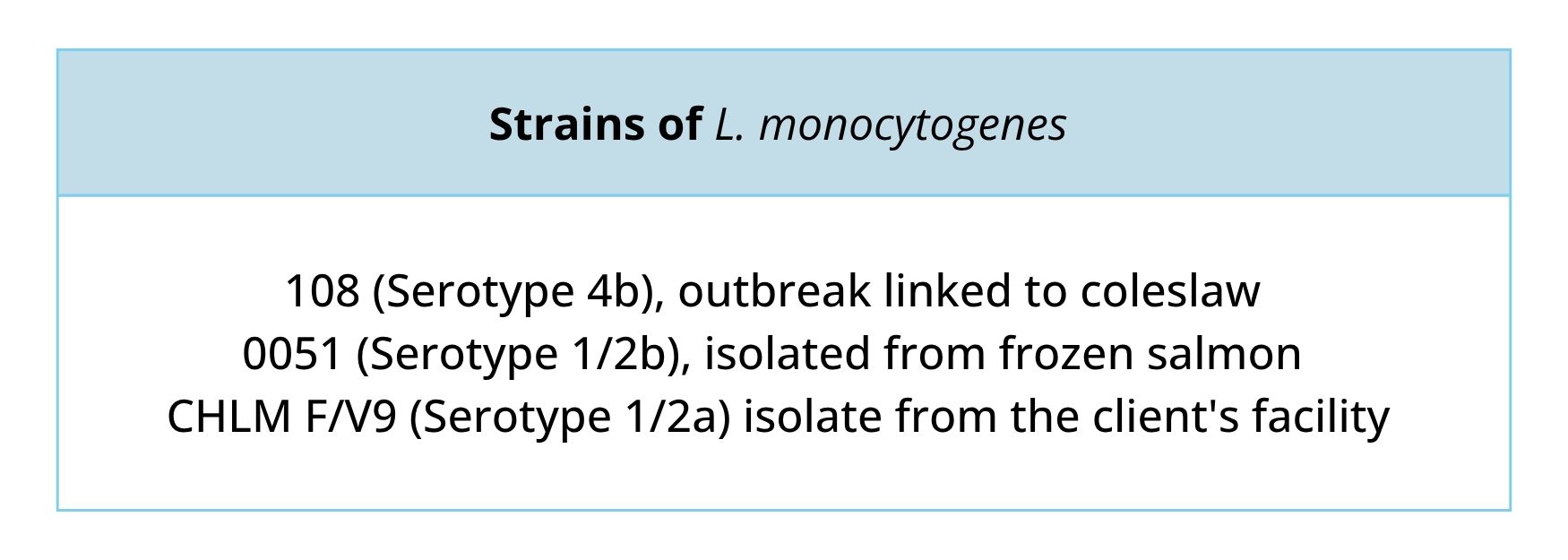
Targeted microorganisms: Each group will be inoculated with a cocktail composed of three strains of Listeria monocytogenes specific for vegetables. The cocktail includes a strain isolated from a listeriosis outbreak (strain 108) and a strain isolated from food in the group type. The cocktail includes three different serotypes (1/2a, 1/2b and 4b).
Batch division: The experiment is divided in four groups, every sample of 25g ± 0.5g is analysed in triplicate at each time point of the study. Group 1 is the negative control (the unmodified food). Group 2 is the positive control (food inoculated with 1000 cfu/g of Listeria monocytogenes). Group 3 is inoculated at the same level of Group 2 but previously treated with Inneoat the plant and Group 4 is the same as group 3, but previously sprayed with Inneo in laboratory.
Food preparation: Food will be weighed and divided in sterile containers. Because the contamination happens at the surface of the food, samples will be inoculated and treated at the surface. Food must be kept frozen at all times, so samples are kept at -15°C during storage and on ice during the time of the experiment. The temperature will be monitored with an infrared thermometer and sample will not thaw at more than -5°C.
Inoculation: Strains are grown aerobically in TSBYE at 37°C for 24h and subcultured at 1% in the same conditions for 18h. Each strain of the group is then diluted to reach a level of 108 cfu/ml in saline solution 0.85%. They are adapted to the cold at 4°C for 48h up to 1 week before being used in the experiment. 24h before the experiment, the strains are enumerated and diluted to 100 000 cfu/ml. All the strains are then pooled together to form the inoculation cocktail. On the day of the experiment, 150 μl is evenly spread on the surface of the food of Group 2, 3 and 4 for an inoculum of 1Log per gram of food, or 3Log per gram of food.
INNEO treatment (A2-Labo): Food will be previously sprayed at the plant according to the manufacturer’s instructions for Group 3. For Group 4, 1 ml of Inneo will be sprayed at the surface of the samples. Samples will be evenly mixed by hand for 7 seconds and let to rest for 10 minutes before inoculation.
Storage conditions: After inoculation, samples will be thawed at 7°C and kept at 7°C for 12 days.
Sampling plan: Each food is analyzed at the day of the inoculation/treatment (D0 = 4h), at days 2, 7, 10 and 12 following the inoculation.
Enumeration method: MFLP-74 – Enumeration of Listeria monocytogenes in food, from the Compendium of Analytical Methods, Volume 3 of Health Canada. PALCAM is used as the plating media.
Performance criteria: Antimicrobials must not allow the pathogen to grow at more than 0.5Log cfu/g or more.
Statistical analysis method: Figure are made with the program JMP 10.0.0 and statistical analysis are made by comparing the batches together for each day separately with an ANOVA and using ‘’Student’s t’’ variable to compare the means. P values on the graphs will display only the differences of the antimicrobial compared to the positive control. P values < 0.0001 are represented with ****, p values < 0.001 are represented with ***, p values < 0.01 are represented with ** and p value <0.05 are represented with *. Statistical groups are also presented. Groups linked by the same letter are not significantly different from each other with a p value < 0.0001. Which means that groups that have different letters are different from each other.
Discussion
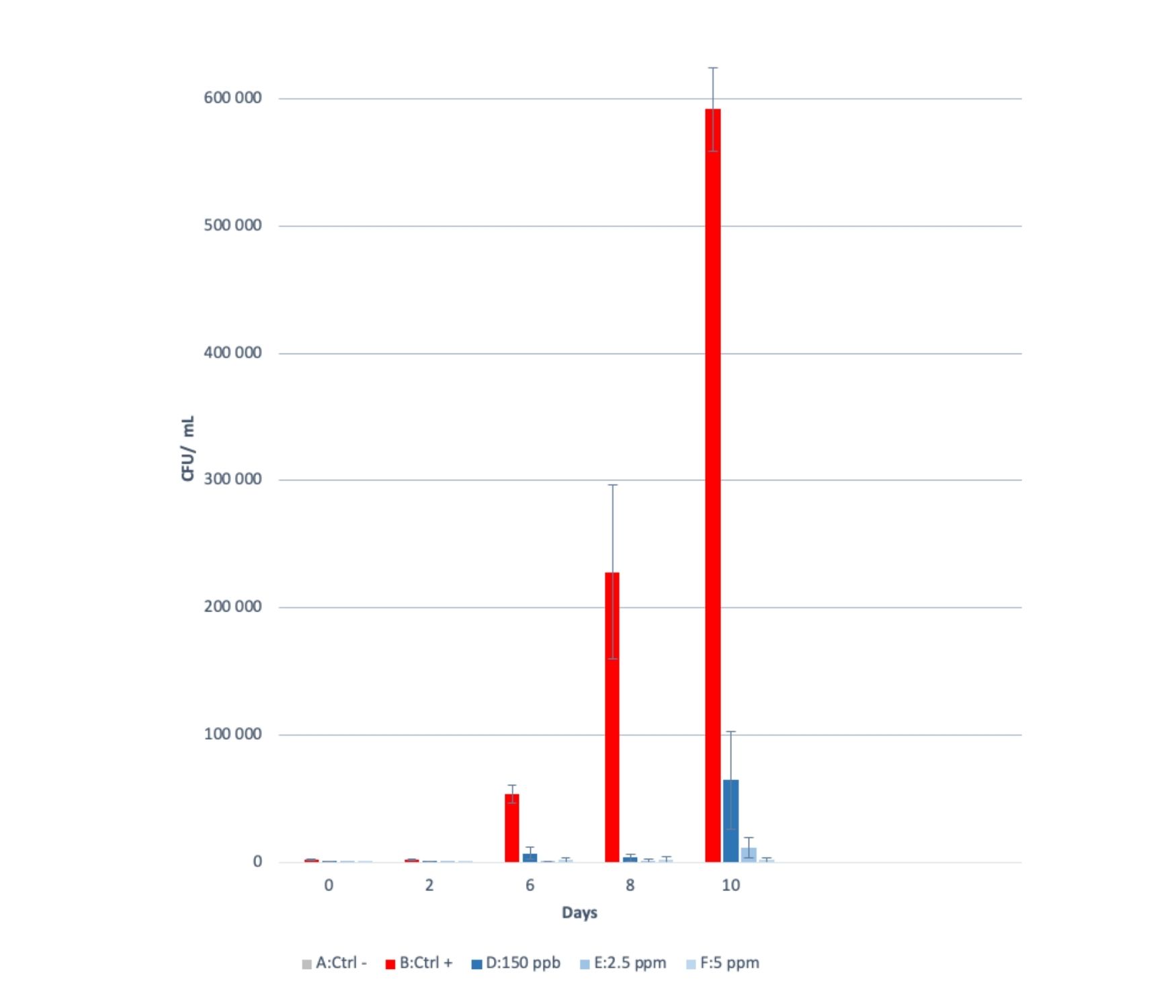
The data show that applying INNEO directly onto frozen vegetables can introduce an antimicrobial effect before thawing even occurs. Although the initial reductions in Listeria monocytogenes were modest (0.2–0.6 Log depending on matrix), they were achieved on a fully frozen substrate, where lethality is typically limited. More importantly, once products were thawed and held at 7 °C, INNEO delayed pathogen growth for at least seven days and consistently maintained increases within the +0.5 Log CFU/g regulatory threshold. This performance was observed across two vegetable types, two inoculum levels, and two application formats, indicating that upstream use can still provide downstream protection during chilled exposure.
The eventual increase in counts after Days 10–12 coincided with visible deterioration of the vegetables, suggesting spoilage and loss of product integrity rather than failure of the antimicrobial. This reinforces the commercial relevance of a seven-day protection window, which aligns with typical distribution, storage, and retail handling of thawed vegetable products. The approach requires no formulation change or label impact, operates as a surface intervention, and follows a recognized analytical method, supporting use in validation files and preventive control programs.
Conclusion
INNEO demonstrated measurable lethality at application and effectively restricted Listeria monocytogenes growth to within +0.5 Log CFU/g for seven days at 7 °C, meeting the Health Canada challenge-test criterion. For processors managing Listeria risk in frozen-to-refrigerated supply chains, these findings support INNEO as a practical, labeling-neutral antimicrobial option that can be integrated into existing production without disruption, adding meaningful protection during the highest-risk phase of distribution.