


Objective
For food manufacturers, selecting an antimicrobial intervention involves more than demonstrating activity under laboratory conditions. The technology must also remain effective when incorporated into complex food formulations, where ingredients can potentially interfere with antimicrobial performance.
The objective of this study was to evaluate the compatibility of INNEO® with multiple fruit-based smoothie formulations and determine how the product maintains its anti-Listeria activity after exposure to these matrices. A secondary objective was to better understand the behavior of Listeria monocytogenes in representative smoothie formulations under different storage conditions.
Methods
Four fruit-based smoothie formulations were evaluated for compatibility with INNEO®. The antimicrobial was mixed with each smoothie matrix at a 1:1 ratio and incubated at 4°C for periods of 3 and 8 hours.
Following incubation, samples were centrifuged, and the recovered supernatants were tested using a soft agar diffusion assay. Residual antimicrobial activity was measured against both Listeria ivanovii, a highly sensitive indicator organism, and Listeria monocytogenes, a major foodborne pathogen of concern in ready-to-eat foods. The diameter of the inhibition zones was used as an indicator of antimicrobial effectiveness following exposure to the smoothie matrices. A challenge study was also conducted using a three-strain cocktail of Listeria monocytogenes representative of food-associated contamination events. Two smoothie formulations were inoculated and stored under refrigerated (4°C) and ambient temperature conditions for seven days. Bacterial populations were monitored throughout the study to evaluate the behavior of L. monocytogenes within these products during storage.
Results
Compatibility tests
| Formulation | L. ivanovii | L. monocytogenes | ||
|---|---|---|---|---|
| 3 h | 8 h | 3 h | 8 h | |
| INNEO® Control | 24 | 23 | 23 | 22 |
| Fruit & Vegetable Blend A | 19 | 18 | 16 | 16 |
| Fruit & Vegetable Blend B | 22 | 22 | 20 | 20 |
| Fruit & Vegetable Blend C | 24 | 23 | 21 | 22 |
| Fruit & Vegetable Blend D | 23 | 23 | 20 | 19 |
Across all formulations tested, INNEO® retained substantial anti-Listeria activity following contact with the smoothie matrices.
The measured inhibition zones remained comparable to those observed with the antimicrobial control, demonstrating that the fruit-based formulations had little impact on product performance. While one formulation exhibited a slight reduction in activity, the antimicrobial effect remained strong and stable throughout the evaluation period.
No meaningful differences were observed between the 3-hour and 8-hour exposure times, indicating that prolonged contact with the smoothie matrices did not significantly reduce the effectiveness of INNEO®. These findings demonstrate strong compatibility between INNEO® and fruit-based beverage formulations.
Challenge Test
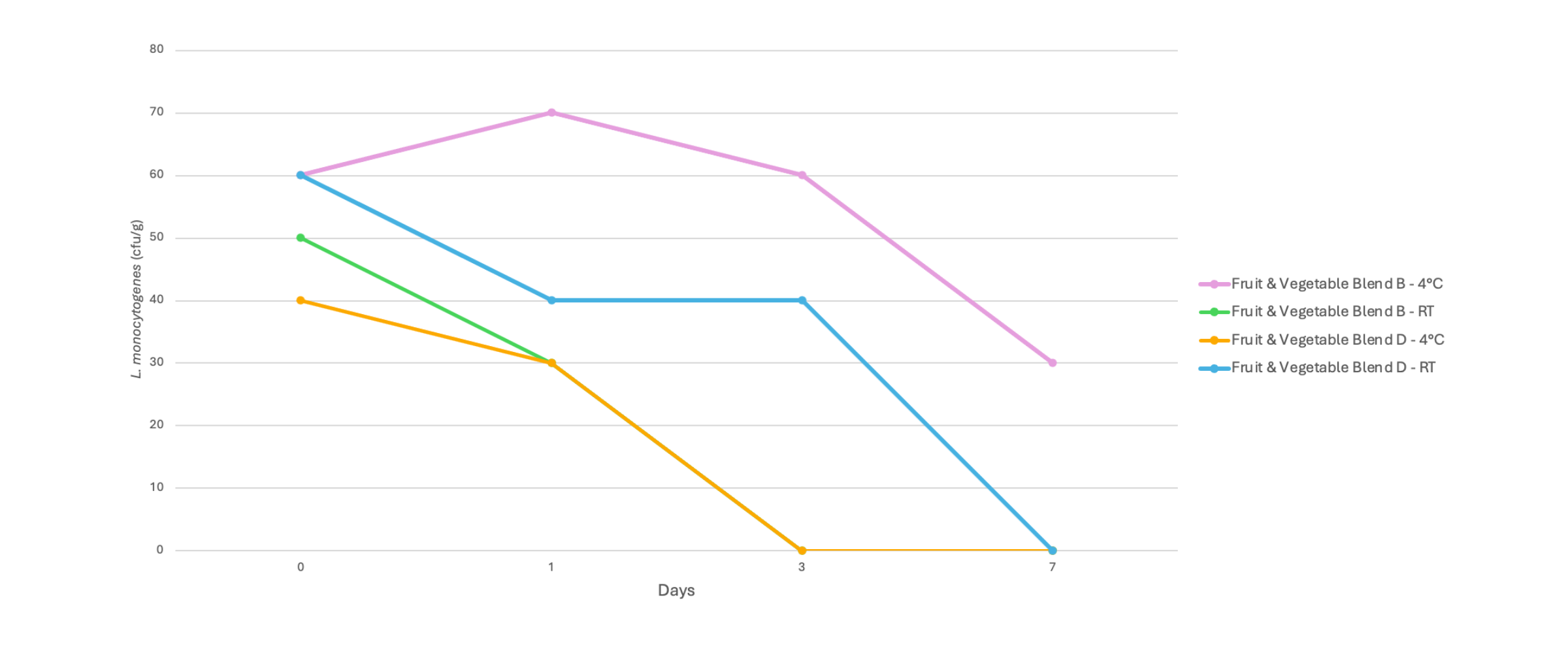
The challenge study provided additional insight into the behavior of Listeria monocytogenes within the evaluated smoothie formulations during storage. Throughout the study, no increase in L. monocytogenespopulations was observed under the tested conditions. The results confirmed that the selected formulations did not promote pathogen growth over the evaluation period.
While these findings contribute to the understanding of microbial behavior in fruit-based beverages, the most significant outcome of the study was the demonstration that INNEO® maintained its antimicrobial functionality within these complex food matrices.
Discussion
Food formulations contain a wide range of components that can influence antimicrobial performance. Organic acids, sugars, fibers, enzymes and naturally occurring plant compounds may interact with antimicrobial ingredients and reduce their effectiveness once incorporated into the final product. For quality assurance and food safety professionals, this represents an important challenge. Antimicrobial technologies must demonstrate not only laboratory efficacy but also formulation compatibility.
The results of this study provide strong evidence that INNEO® remains active after exposure to multiple fruit-based smoothie formulations. The technology maintained significant anti-Listeria activity despite contact with complex food matrices, demonstrating its ability to perform under realistic application conditions.
This evaluation was initiated in response to a specific food safety concern associated with one of the ingredients used in the formulation. Leafy greens, including kale, are recognized as raw materials requiring particular attention with regard to Listeria monocytogenes control due to their growing environment, post-harvest handling practices, and frequent use in ready-to-eat foods. Health Canada also emphasizes the importance of implementing effective and validated control measures for ready-to-eat foods that may be exposed to this pathogen. Beyond Canadian regulatory requirements, controlling Listeria monocytogenes is also a major commercial consideration for companies exporting to the United States. The U.S. Food and Drug Administration (FDA) applies a particularly stringent approach to Listeria in ready-to-eat foods. The detection of L. monocytogenes can result in product recalls, regulatory investigations, warning letters, or product detention at the border in certain food categories.
From a risk management perspective, this is a critical consideration. Even in products that are not expected to support pathogen growth, manufacturers must continue to manage the possibility of contamination resulting from raw materials, processing environments, equipment, or operational deviations. An antimicrobial intervention that remains active during the critical early window after application can provide an additional layer of protection as part of a broader food safety strategy. By extending coverage into the finished product, INNEO® can contribute to a multi-hurdle approach designed to strengthen microbial control and enhance confidence in product safety. For manufacturers working with ingredients such as leafy greens, this additional hurdle may help support preventive control programs and reinforce overall food safety management efforts.
Conclusion
This study demonstrated that INNEO® maintains strong anti-Listeria activity after exposure to multiple fruit and vegetable-based smoothie formulations. The compatibility assessment showed that complex fruit matrices did not significantly interfere with antimicrobial performance, confirming that INNEO® remains functional under realistic product conditions. For food manufacturers seeking to strengthen food safety programs and support risk management initiatives, these findings demonstrate the potential of INNEO® to serve as an effective additional hurdle within fruit-based beverage applications.