

Use of INNEO™ as a processing aid in food
INNEO™ is a bacteriocin-based antimicrobial processing aid composed of the protein Pediocin PA-1 M31L, produced by Pediococcus acidilactici. Designed to combat Listeria monocytogenes and other Listeria spp., INNEO™ provides a targeted, natural solution for food safety. It is intended for application across a wide range of food categories, including meats, dairy, seafood, fruits, vegetables, and ready-to-eat products. The product exerts a temporary technical effect and is rapidly degraded on food matrices, aligning with regulatory expectations for processing aids. INNEO™ has received a letter of no objection from Health Canada and the CFIA as an antimicrobial processing aid. In the United States, INNEO™ has GRAS status, supported by scientific procedures and safety data demonstrating no impact on the nutritional value or sensory characteristics of treated foods, as well as an authorization letter from USDA-FSIS.
Degradation Data
The degradation of INNEO™ on food is primarily driven by proteolytic activity inherent to food matrices. Proteases such as trypsin, papain, and proteinase K, naturally present on raw meats, vegetables, fish, dairy and all foods, rapidly degrade INNEO™ into natural amino acids. Quantitative analysis across various food surfaces confirmed protease concentrations ranging from 4.2 µg/g (mixed vegetables) to 337.7 µg/g (smoked salmon), vastly exceeding the applied INNEO™ concentration of 5 µg/g. This ensures that degradation is not only probable but accelerated.
Using LC-MS, an internal study confirmed that INNEO™ loses all detectable antimicrobial structure upon contact with proteases: complete degradation occurred in under 60 minutes, with some enzymes (e.g., proteinase K and pepsin) degrading it instantly. No residual antimicrobial activity remains post-degradation, as the bacteriocin’s efficacy depends on its intact tertiary structure.
The limit of detection (LOD) and lower limit of quantification (LLOQ) were also established in real food matrices using a high-sensitivity mass spectrometer, showing LOD (limit of detection) between 0.25–2.5 ppm and LLOQ (lower limit of quantification) between 0.5–5 ppm depending on the food. Given that INNEO™ is typically applied at 0.15 ppm, and at a maximum of 5 ppm, and rapidly degrades below LLOQ due to natural protease action, its residue is deemed negligible and not detectable after application. In those same food models, it was measured that the concentration of INNEO™ rapidly diminished under the limit of detection in less than 24h (see figure 1).
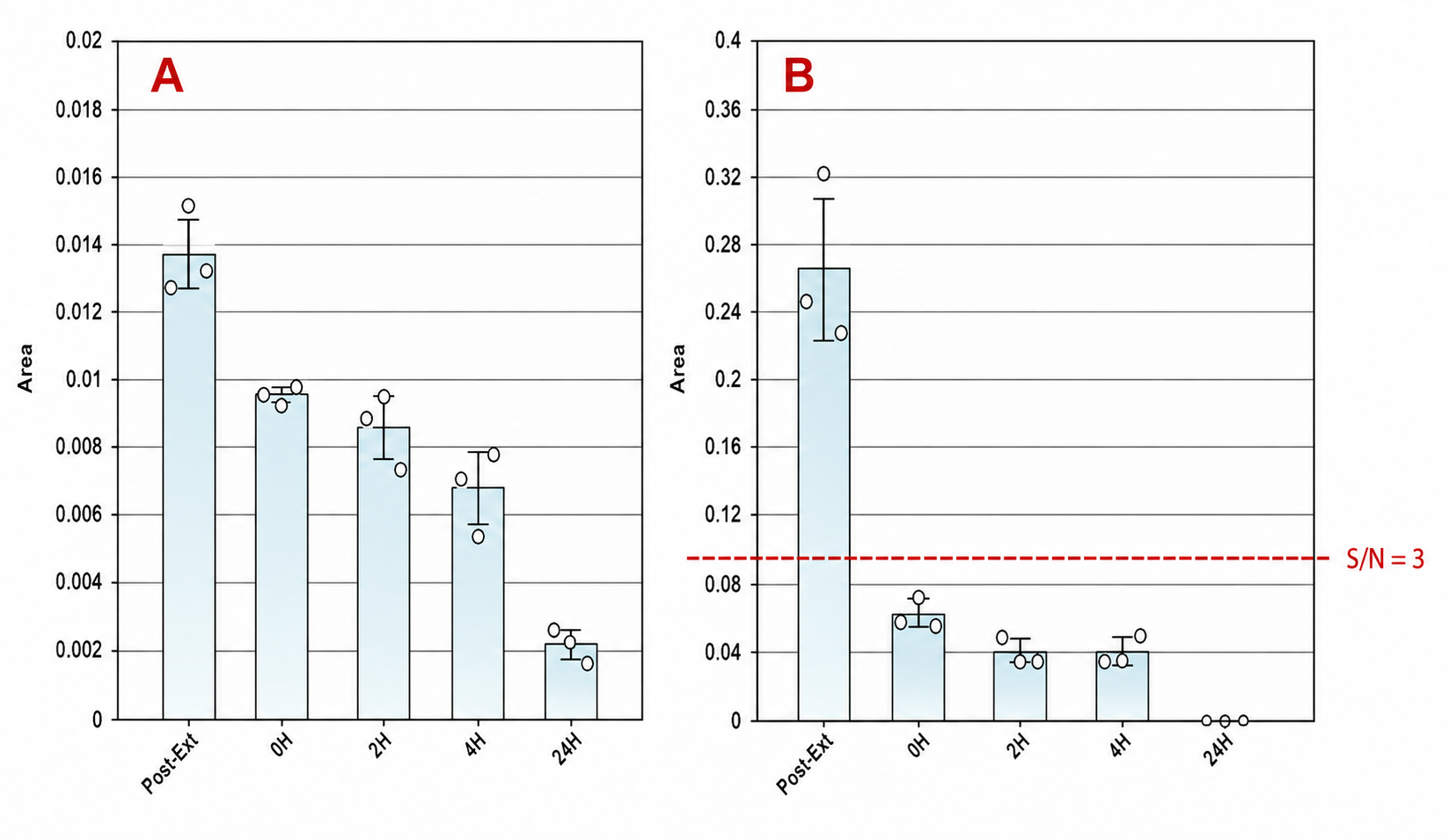
Figure 1. Relative abundance of INNEO™ spiked at 5 PPM in zucchini samples (A) and salmon (B) at different incubation times.
Here, we can see that the abundance of INNEO™ in vegetables (A: zucchini) rapidly drops under 24h to almost undetectable concentrations. It is constant with the fact that vegetables have a smaller amount of proteases. When using food with a high protease content (B: salmon), the abundance of INNEO™ is already under the limit of detection (S/N=3) upon application.
Regulatory Status
INNEO™ is currently used as a processing aid in Canada and in the United States. INNEO™ received a letter of no objection from CFIA in 2020 for use in food as a processing aid. The following link can give access to the list of permitted processing aids in Canada.
As of August 2024, INNEO™ is considered GRAS (Generally Recognised as Safe) by the U.S. FDA for use in food categories covered under GRN 001164, except infant formula. Additionally, pediocin (s-PA-1) can be found in the list of substances that may be used in the production of meat, poultry, and egg products under FSIS directive 7120.1.
Conclusion
The data presented demonstrate that INNEO™ rapidly and effectively degrades upon application to food products due to the natural presence of proteases. This degradation results in the complete breakdown of the bacteriocin into its amino acid components, eliminating its antimicrobial activity and structural integrity within a short time frame. In situ LC-MS analyses confirmed that INNEO™ becomes undetectable shortly after application, with residue levels consistently falling below the LOD and LLOQ established for various food types.
Given its proteinaceous nature, natural degradation mechanism, and non-residual profile, INNEO™ meets the regulatory criteria for a processing aid and is suitable for use across the food categories covered by its regulatory approvals, including meat, poultry, seafood, dairy, produce, and ready-to-eat foods. Its temporary technical effect, lack of nutritional or organoleptic impact, and rapid enzymatic breakdown ensure both efficacy and safety, making INNEO™ a robust, clean-label antimicrobial processing aid for Listeria control in the food industry.