

Objective
One of the most common concerns when integrating an antimicrobial solution into a production process is whether it will remain effective after exposure to heat. Many ready-to-eat products are filled or packaged while still warm, which can impact the performance of certain ingredients. To evaluate INNEO®’s robustness under these conditions, a challenge study was conducted using pork pâté. The goal was simple: determine whether INNEO could retain its antimicrobial effectiveness against Listeria monocytogenes after being incorporated into a product at approximately 70°C.
Methods
The study was performed using pork cretons produced under commercial conditions. After preparation, the product was maintained at approximately 70°C to simulate a typical hot-fill or hot-packaging step. Samples were then inoculated with Listeria monocytogenes and stored under refrigerated conditions for 14 days. Two concentrations of INNEO were evaluated and compared against an untreated control. Microbial populations were monitored throughout storage to determine whether antimicrobial activity was maintained after heat exposure.
Treatments
| Treatment | Concentration |
| Heat-treated control | 0 ppm |
| INNEO | 150 ppb |
| INNEO | 5 ppm |
Results
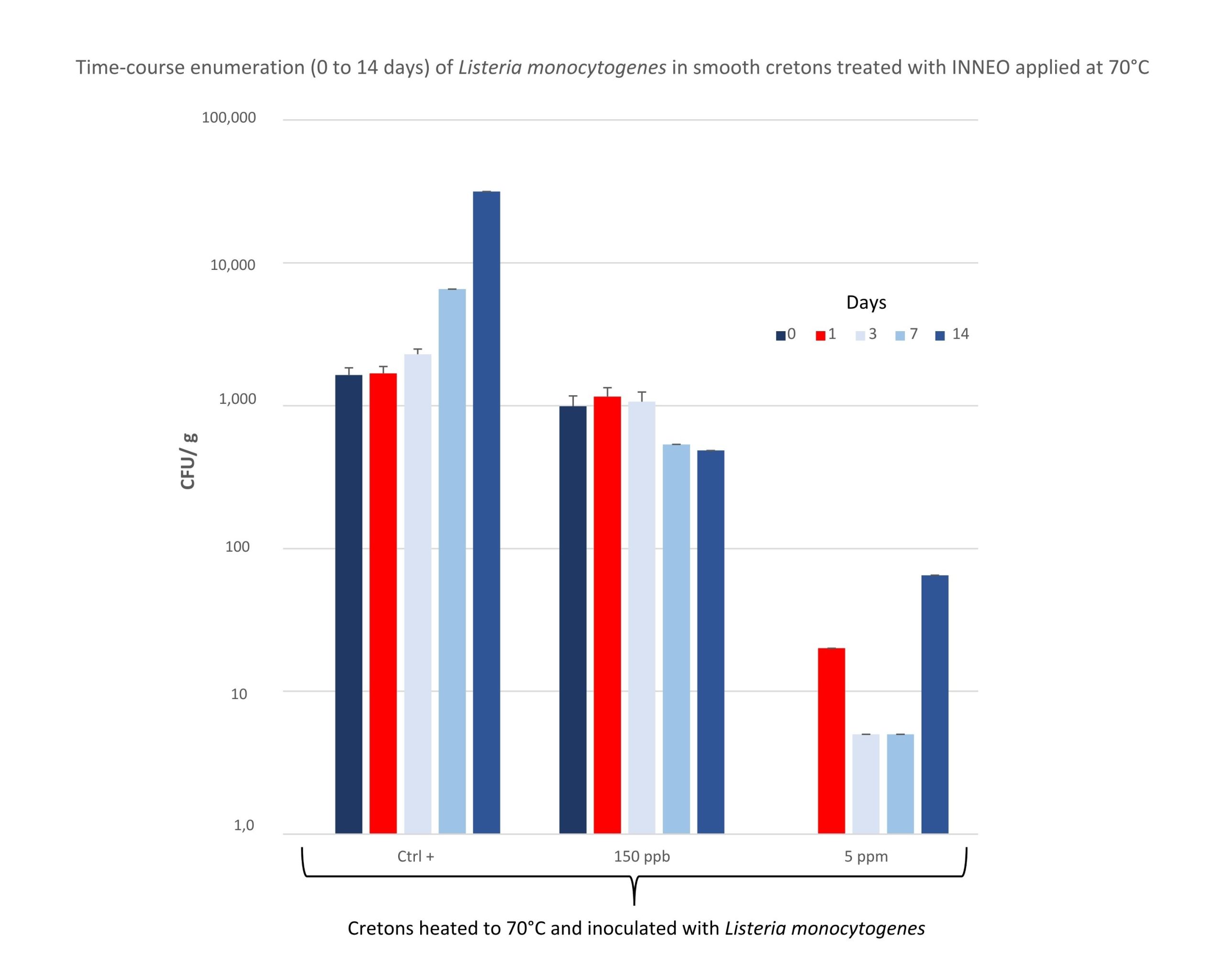
The untreated heated control did not prevent the growth of Listeria monocytogenes during refrigerated storage. Pathogen levels increased from 3.22 Log CFU/g on Day 0 to 4.50 Log CFU/g on Day 14, demonstrating that thermal processing alone was insufficient to control microbial growth over the product’s shelf life.
At the approved application level of 150 ppb, INNEO consistently suppressed Listeria growth throughout the study. While reductions were modest during the first three days, the antimicrobial effect became more pronounced over time, reaching a 1.09-log reduction by Day 7 and a 1.81-log reduction by Day 14 compared with the heated control. No evidence of uncontrolled pathogen growth was observed in treated samples.
At 5 ppm, INNEO delivered an immediate antimicrobial effect, achieving approximately a 3-log reduction on Day 0. This level of control was maintained throughout the study, with Listeria counts remaining substantially lower than those observed in untreated samples. At the higher concentration, microbial populations remained at very low levels throughout the study period, demonstrating strong and sustained antimicrobial activity.
Discussion
The study demonstrated a clear difference between untreated controls and samples treated with Inneo®. Thermal processing at 70°C alone did not prevent Listeria monocytogenes growth during refrigerated storage, with pathogen levels increasing throughout the 14-day study period. In contrast, Inneo® reduced pathogen levels at both concentrations evaluated.
At 150 ppb, reductions increased over time, reaching 1.81 logs by Day 14 compared with the heated control. At 5 ppm, an immediate 3-log reduction was observed, followed by sustained suppression of Listeria throughout storage. Taken together, the results confirm that the reductions observed during the study were attributable to INNEO and that antimicrobial activity was maintained throughout the full storage period under challenge-test conditions.
Conclusion
Under the conditions of this challenge study, INNEO demonstrated antimicrobial activity against Listeria monocytogenes in a ready-to-eat pork product during 14 days of refrigerated storage. Samples treated with INNEO showed lower pathogen counts than untreated controls throughout the study period. These results demonstrate that INNEO remained active in the tested food matrix and provided measurable control of Listeria monocytogenes under challenge-test conditions.